C2 · Buying guide
C2 Corvette Sting Ray buyer's guide (1963–1967): best years, rust, fakes and 2026 prices
Published
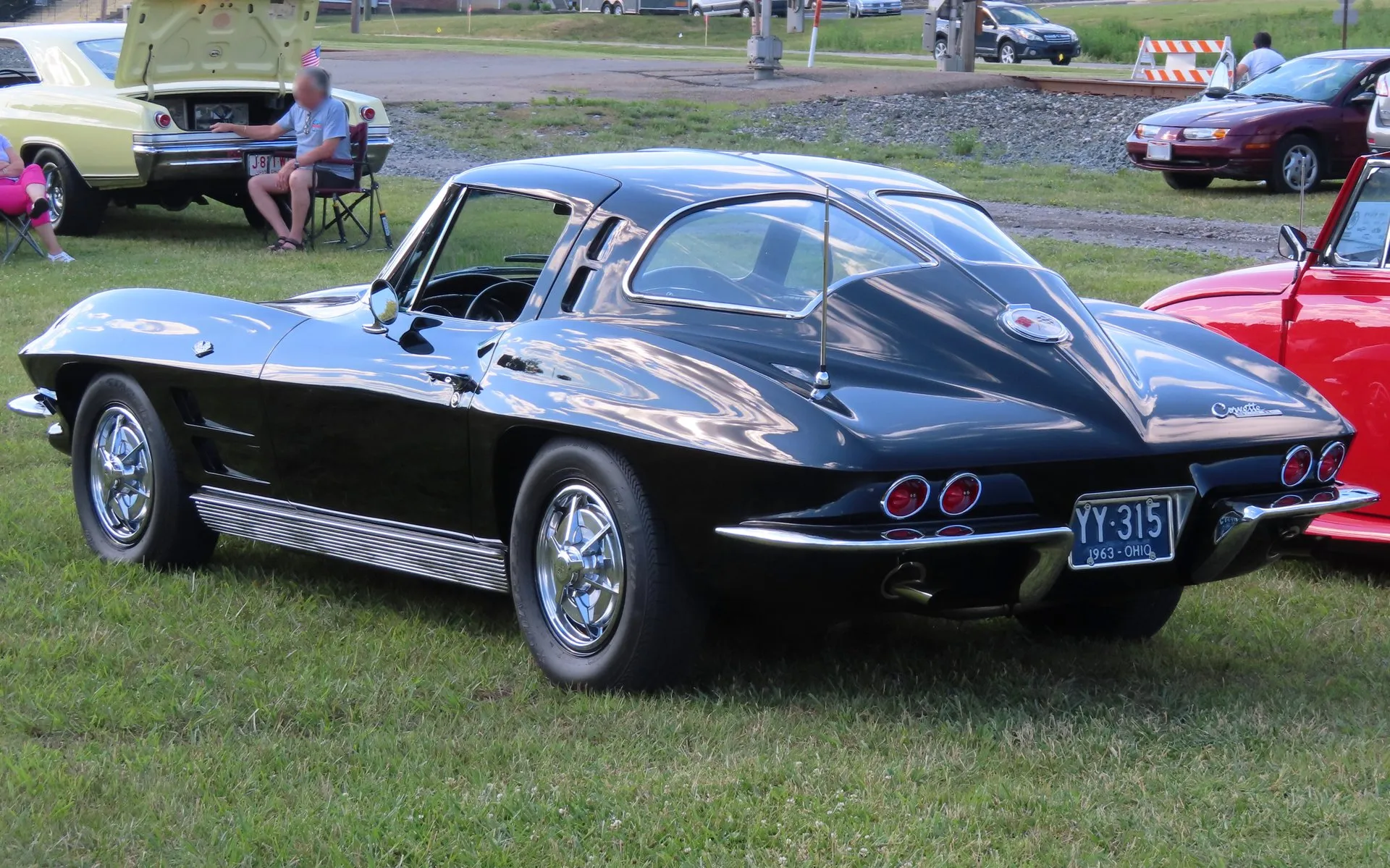
Period road testers griped that the bar down the middle of the new Corvette coupe’s rear window cut up the view behind, and Chevrolet took it out after one model year. Collectors now pay dearly for that bar: between June 10 and October 6, 2026, the median 1963 split-window coupe sold on Bring a Trailer went for $195,000, while the median 1964, coupe or convertible, went for $60,250.
That’s the C2 (1963–1967), the Sting Ray, and it’s the generation that turned the Corvette into a serious sports car: the first Corvette coupe, hidden headlights, a ladder frame and independent rear suspension for 1963, then standard four-wheel disc brakes and the first big-block V8 for 1965. GM built 117,964 of them in five model years, all assembled in St. Louis.
Six decades on, two things decide what a C2 is worth more than its model year does: the steel cage hidden inside the fiberglass body, which rusts, and the paperwork behind any big-block, fuel-injection or split-window claim, because all three get faked.
- Built: 117,964: 45,546 coupes and 72,418 convertibles.
- Horsepower: from 250 hp for the 1963–1965 base engine to 435 hp for the 1967 L71 427, all gross ratings.
- Split window: 1963 coupe only, 10,594 built.
- Brakes: drums for 1963–1964, then four-wheel discs standard from 1965.
- Price: 1964–1967 small-block cars without fuel injection, titled as stock, sold for a median of about $65,000 on Bring a Trailer between June 10 and October 6, 2026 (35 sales).
- Best years: 1963 coupe to collect, 1965–1967 to drive, and 1964 for value.
C2 · 1963–1967 Key figures
- Built
- 117,964
- Production run
- five model years
- Peak power
- 435 hp for the 1967 L71 427
- Split window
- 1963 coupe only, 10,594 built
- Disc brakes
- four-wheel discs standard from 1965
- 1963 coupe weight
- 3,015 lb
- Small-block median, 2026
- about $65,000 on Bring a Trailer
- Best years
- 1963 coupe to collect, 1965–1967 to drive
Section 01
C2 Corvette production, prices and horsepower by year
“Small-block” means the 327, the base engine every year; “big-block” means the 396 of 1965 and the 427s of 1966–1967. Prices are from a dated GM price list in each year’s GM Heritage Center kit; lists changed during the year, so other sources differ slightly.
| Year | Built (coupes / convertibles) | GM list price, coupe / convertible | Base engine | Strongest option |
|---|---|---|---|---|
| 1963 | 21,513 (10,594 / 10,919) | $4,252 / $4,037 | 327, 250 hp | 327 L84 fuel injection, 360 hp |
| 1964 | 22,229 (8,304 / 13,925) | $4,252 / $4,037 | 327, 250 hp | 327 L84 fuel injection, 375 hp |
| 1965 | 23,562 (8,186 / 15,376) | $4,233 / $4,022 | 327, 250 hp | 396 L78, 425 hp |
| 1966 | 27,720 (9,958 / 17,762) | $4,295 / $4,084 | 327, 300 hp | 427 L72, 425 hp |
| 1967 | 22,940 (8,504 / 14,436) | $4,353 / $4,141 | 327, 300 hp | 427 L71, 435 hp |
How many C2 Corvettes were made? 117,964, and the yearly figures add up to that total. They come from the Corvette Black Book pages reproduced in GM’s Heritage Center kits, starting with the 1963 production page, and Corvette Action Center’s tables agree. All five kits are in this site’s owner’s manual library.
Gross ratings. Every horsepower figure here is GM’s gross rating, the yardstick of the day. GM’s 1964 engine data also lists the base 250 hp engine at 210 hp net, the measure GM switched to for 1972 (see the guide to the C3 (1968–1982)).
Section 02
What changed, year by year
1963: the first coupe and the split window
The body and chassis were all new: the first Corvette coupe, the first hidden headlights, a ladder frame in place of the X-braced frame of the C1 (1953–1962), and fully independent rear suspension, with a fixed differential, a transverse leaf spring and U-jointed half shafts. GM lists the Sport Coupe at 3,015 lb on a 98.0 in wheelbase. Brakes were 11 in drums. The split rear window and the trim in the hood’s two recesses were both gone for 1964.
The 327 came at 250, 300, 340 and 360 hp, the last with Rochester fuel injection (2,610 cars); Powerglide, power steering and air conditioning weren’t offered with the two strongest. The four-speed changed from Borg-Warner to Muncie during production.
The Z06 package went on 199 cars. It launched at $1,818.45, coupe only, with a 36.5-gallon tank and knock-off wheels, then dropped to about $1,293 without them and opened to convertibles. GM’s price list describes power brakes with a dual-circuit master cylinder, metallic brakes and heavy-duty suspension, with the 360 hp fuel-injected engine, four-speed and Positraction included. The knock-off wheels’ porosity made tires leak, and no 1963 is confirmed delivered to a retail buyer with them.
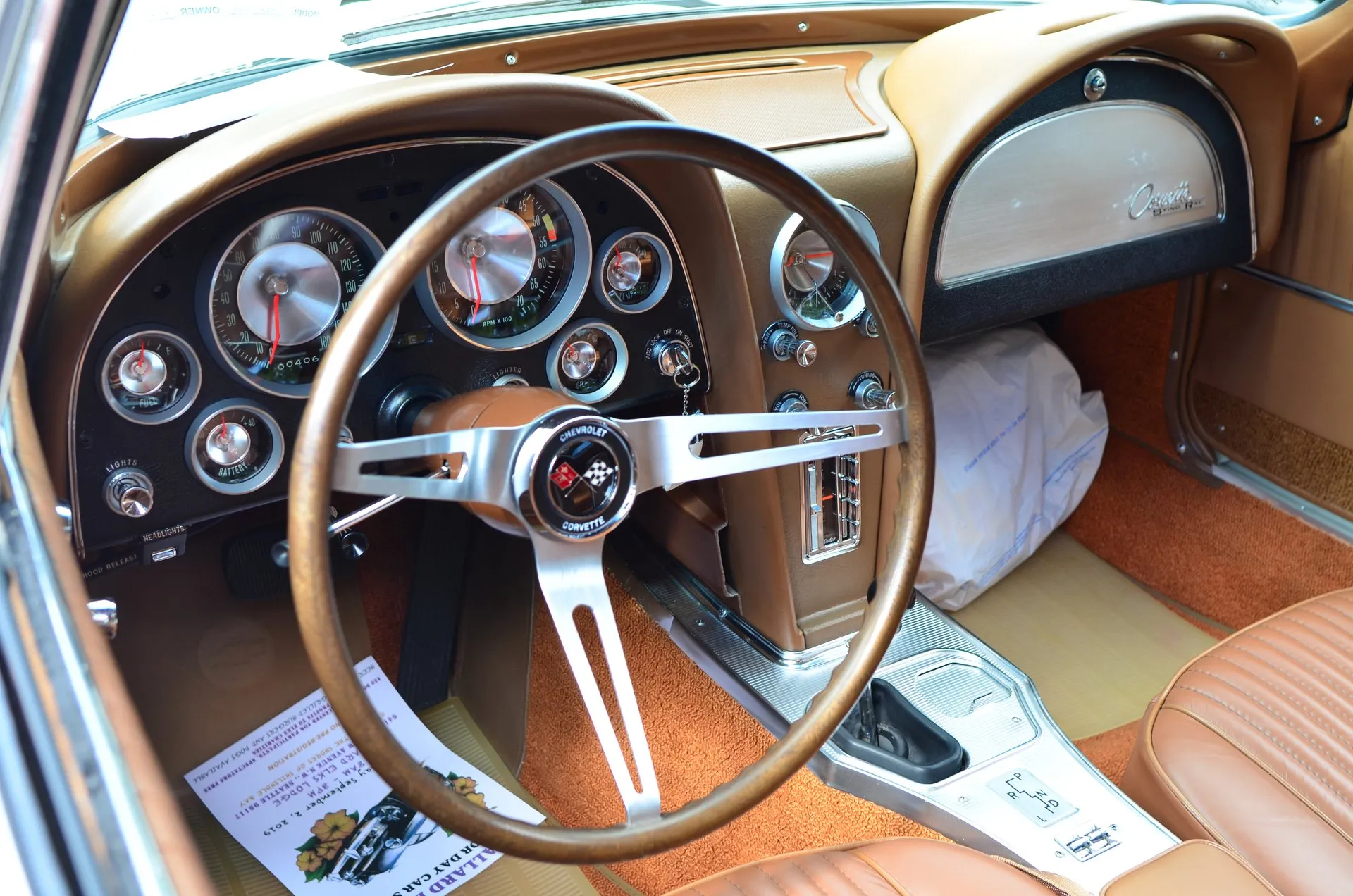
1964: cleaner, and the cheapest C2 today
The split and the hood trim went (the recesses stayed), and coupes got a fan that pulled air through vents in the driver-side roof panel. The L76 rose to 365 hp and the fuel-injected L84 to 375 hp (1,325 cars), both four-speed only. Knock-off wheels reached customers this time, on 806 cars. Some 1964–1967 bodies came from Dow-Smith in Ionia, Michigan, a division of A. O. Smith, but every car was assembled in St. Louis.
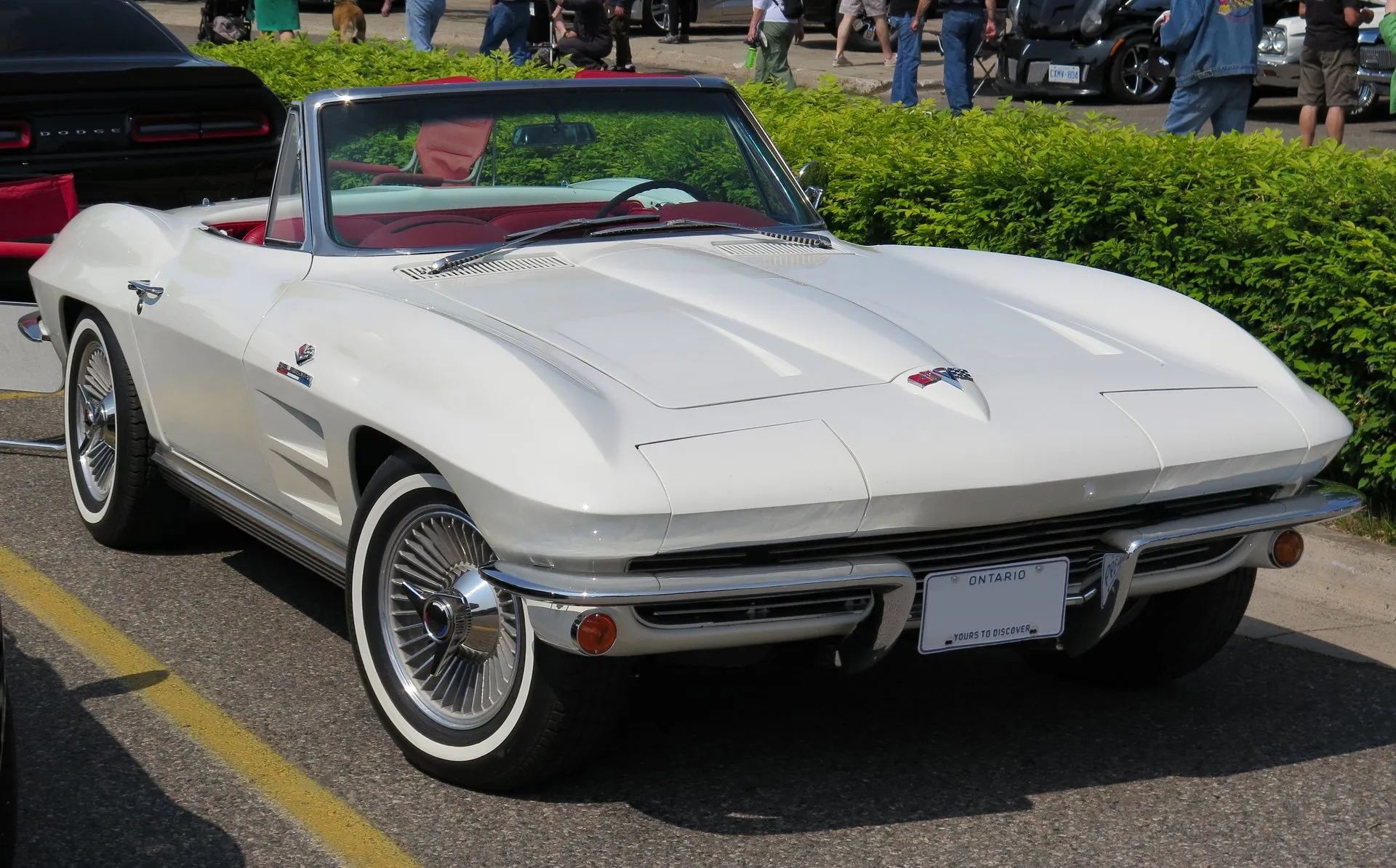
1965: disc brakes, the last fuelie and the first big-block
Four-wheel disc brakes became standard, with 11.75 in rotors and four pistons in each caliper; 316 buyers took drums as a credit option while supplies lasted. Three vertical vents appeared in the front fenders, and the 350 hp L79 327 arrived. Fuel injection had its last year until 1982, on 771 cars. In mid-March came the L78 396, rated 425 hp and 415 lb-ft, with its own hood: 2,157 were built.
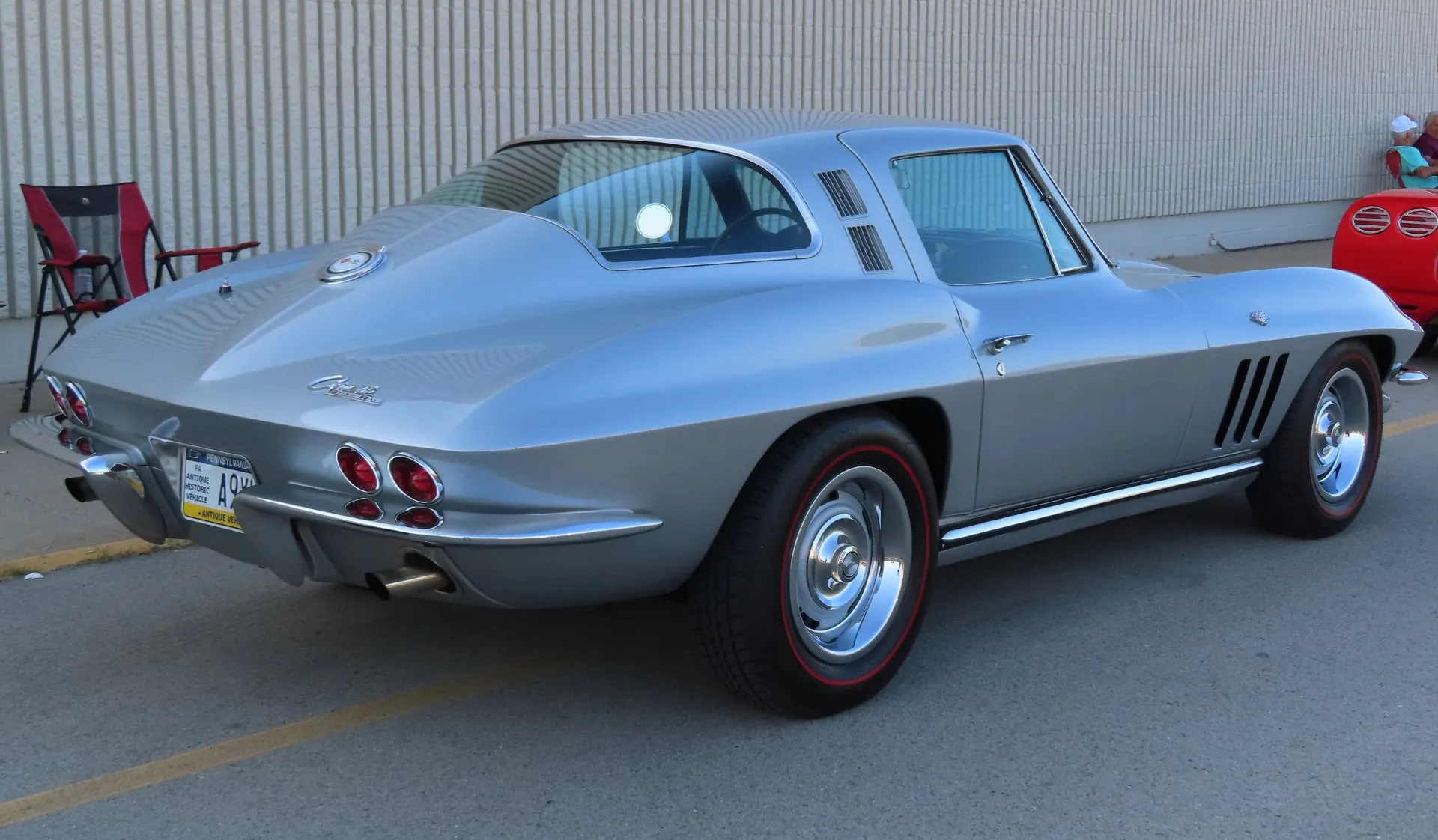
1966: the 427
The 427 replaced the 396: the L36 at 390 hp, with a four-speed or Powerglide, and the solid-lifter L72 at 425 hp, close-ratio four-speed only, both rated 460 lb-ft. The Black Book says the L72 was first listed at 450 hp and then, “for reasons unclear”, rated 425, with no change to the engine. GM built 5,116 L36s and 5,258 L72s. Motor Trend’s March 1966 test of a 427/425 with 4.11 gears ran 0–60 mph in 5.6 seconds and the quarter mile in 13.4 seconds at 105 mph, as reported by Corvette Action Center.
The 300 hp 327 became the base engine, fuel injection and the roof vents were gone, and a plated square-mesh grille arrived. It was the last year for knock-off wheels.
1967: the last midyear
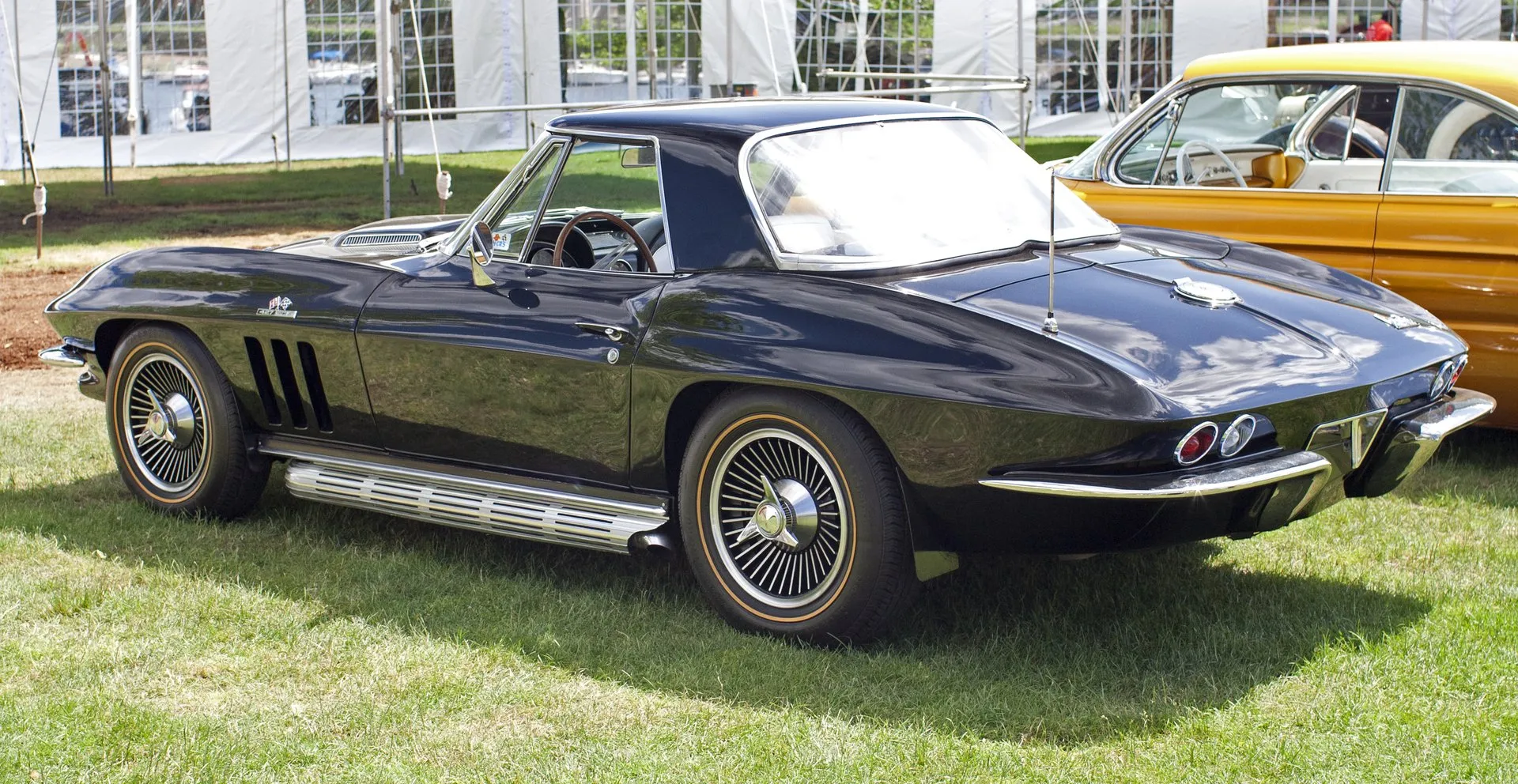
Owners call the 1963–1967 cars midyears, and the 1967 is the last: five fender vents, no hood script or fender flags, and the parking brake between the seats. Safety legislation replaced the knock-offs with bolt-on cast aluminum wheels, Rally wheels became standard, and big-blocks got their own hood scoop.
The 427s now came at 390 hp (L36), 400 hp (L68) and 435 hp (L71), the last two on three two-barrel carburetors; the L71 was close-ratio four-speed only, without air conditioning. The L88 was a $947.90 option on 20 cars, rated 430 hp; Hagerty says most outside estimates of its output are “well over 500”.
Section 03
Known C2 problems, and why the federal records are almost empty
NHTSA, the US road safety agency, holds two owner complaints for all five years: a 1964 and a 1966, filed in 2000 and 1996, each saying a rear wheel came off. Neither gives a cause (opens in new tab), so this guide won’t guess one. Both were filed 30 to 37 years after the cars were built, and two records are not a pattern.
NHTSA has no GM recalls on file for these cars. The only recall listed for 1965–1967 is for a replacement part: Cardone remanufactured rear calipers (opens in new tab) made from February 2002 to April 2003, part numbers 18-7019, 18-7020, 16-7019 and 16-7020 (aftermarket), whose piston seals can leak. NHTSA’s bulletin files, which start in 1995, hold no GM bulletin for any Corvette before the 1984 model year. The rest comes from owners, biggest bill first.
Birdcage rust
GM’s 1963 shop manual calls it “a structural network of steel” forming the backbone of the body; owners call it the birdcage. On a coupe it frames the whole cabin, from the door pillars and sills up to the windshield header. The fiberglass doesn’t rust. This does, usually from water leaking in at the windshield. Owners point to the lower windshield corners, where midyears are “famous for leaking” (opens in new tab), and the lower front of the door openings (Corvette Action Center forum, 2004), and to the windshield pillars (CorvetteForum, 2010). A rotten birdcage is a very expensive repair (Corvette Action Center forum, 2004), and it usually comes with frame rust (CorvetteForum, 2023).
Frame rust
The kick-up is where the frame rises over the rear axle. The critical spot, per a 2023 CorvetteForum thread, is where the kick-ups weld to the main rails behind the seats; on a convertible, a weak frame also loads the birdcage. The rail’s end cap usually goes first, because dirt packs in and stays wet. It isn’t structural, but the trailing arm pocket beside it very much is (CorvetteForum, 2001). Frames rust from the inside out, so surface scale alone doesn’t condemn one. Small sections can be replaced with the body on; a rotten rail means the body comes off.
Old crash damage
Fiberglass hides old repairs well. Owners check hood and headlight fit and the bonding strips that join the panels (Corvette Action Center forum, 2004), and Hagerty adds stress cracks.
Brakes
The original 1965–1967 disc calipers leaked as their bores corroded, and rebuilds with stainless steel sleeves cure that (CorvetteForum, 2013 and 2025). Sleeved calipers can still weep after contaminated fluid or long storage, but with fresh fluid every few years they give years of service; one owner reports 15 on his 1966 (CorvetteForum, 2025). As for the 1963–1964 drums, one owner’s view is that they stop a 1964 “just fine” (CorvetteForum, 2022).
Fuel injection
Owners with decades on Rochester fuel injection call it reliable on the highway and under load. The weak spot they share is stop-and-go traffic in hot weather, where it can run rough and want to die (opens in new tab) (CorvetteForum, 2012). They split on why: one blames ethanol fuel, another says no special fuel is needed. That’s one thread’s experience, not a rule.
Running hot
Diagnose before buying parts. Posters in a 2020 CorvetteForum thread say to confirm the real temperature with an infrared thermometer, then check vacuum advance, timing, the fan clutch and scale in the block. In that thread the heat was real: a head gasket leak that ended with a new block.
Parts made for the C2 alone
Hagerty notes that the suspension, the hidden headlights and much of the interior are largely unique to the C2, and owners say the 1963 has many one-year and part-year-only parts (CorvetteForum, 2022). Buy a car complete.
Section 04
What to check before buying a C2
- Get it on a lift (CorvetteForum, 2023).
- The frame. The kick-ups where they weld to the main rails behind the seats, the kick-up gussets near the #3 body mount, the trailing arm pockets and the rail ends. Probe anything soft with a screwdriver (CorvetteForum, 2001).
- The trailing arms. Tap their bottoms; they can rust from inside (CorvetteForum, 2010).
- The birdcage. Pull the kick panels, drop the glove box to see the right side of the cage, and check the lower windshield corners, where the leaks start, and the lower front of each door opening (Corvette Action Center forum, 2004; CorvetteForum, 2010).
- Crash repair. Panel gaps, hood and headlight fit, bonding strips, stress cracks and the lower radiator support (Corvette Action Center forum, 2004; Hagerty).
- Brakes. Weeping calipers, and on a 1965–1967, rear calipers carrying one of the recalled Cardone part numbers (see Known C2 problems).
- Temperature, checked with an infrared thermometer (CorvetteForum, 2020).
- The numbers and the paperwork, if the price depends on the engine, the fuel injection or the rear window (see Originality and fakes).
- An inspector who knows C2s. One poster advising a buyer suggests at least a master-level NCRS judge, a Bloomington Gold judge or a C2 specialist, and local NCRS chapters can recommend people (CorvetteForum, 2020). Another suggests the best local Corvette mechanic as a sounding board (Corvette Action Center forum, 2002–2003).
Section 05
Originality and fakes: what the paperwork has to prove
The money in a C2 sits in its engine code and, on a 1963 coupe, its rear window. On Bring a Trailer from June to October 2026, big-blocks whose listing titles named a factory engine code (L36, L68, L71, L72 or L78) sold at a median of $129,000, against about $65,000 for 1964–1967 small-block cars. No surprise, then, that one poster calls big-blocks “probably most counterfeit” (opens in new tab) of all C2s (CorvetteForum, 2020).
What the numbers can and can’t tell you
Nothing in a C2’s VIN or trim tag records its engine, as GM’s own serial-number pages and an identification guide reproduced in the 1966 kit show. The VIN gives the model year, body style, plant (S for St. Louis) and a production number, and the trim plate under the dash adds the build date, body maker, trim and paint. The engine is stamped on its own pad at the right front of the block; on a 1966 that stamp carries the plant, date, an engine suffix code and the car’s production number. The stamp and the casting number say what the block is, not what the car left the factory with: pads can be restamped and big-block parts swapped in (Corvette Action Center forum, 2005; CorvetteForum, 2002).
Big-block cars differed in springs, sway bars, oil gauge, clutch and tach redline (CorvetteForum, 2007–2008), but every one of those details can be copied (Corvette Action Center forum, 2005). The safe rule, from one poster (CorvetteForum, 2002): if the transmission, rear axle and tach dates don’t fit the build date, only real documentation proves the engine, and the safe assumption for value is a base-engine car. One poster jokes that of the 20 L88s built, 36 documented survivors exist (Corvette Action Center forum, 2005). It’s a joke, and it makes the point.
Conversions sold openly, and counterfeits
NCRS, the National Corvette Restorers Society, draws the line. Restoring a car to how it left the factory is restoration. Restamping a small-block car’s engine (opens in new tab) to look like an original big-block, converting a carbureted car to fuel injection with numbers to match, or changing the paint or interior and altering the trim tag to suit, is counterfeiting.
Not every changed car is a fraud. Owners build L88 clones and tributes openly (CorvetteForum, 2014), and Bring a Trailer sold disclosed conversions in 2026: a 1964 coupe turned into a split window on a tube-frame chassis with an LS-based engine ($250,000 on July 14, then $243,000 on October 6), and a 1966 convertible that started life as a coupe ($85,000 on September 23). Posters doubt that faking a split window pays, given all the one-year 1963 parts it takes (CorvetteForum, 2013 and 2015).
Papers that help
- The Protect-O-Plate. From the 1965 model year, Chevrolet owners got an embossed metal plate with the warranty booklet that can help show a car’s original equipment.
- NCRS shipping data. For members, NCRS supplies the selling dealer and production date from GM’s shipping records for cars built from late 1962 to 1975 (with some gaps), but not the options: $50 for the report as of October 2026.
- Ownership history as far back as it goes, and date-coded parts that fit the build date.
What judging awards prove
NCRS Top Flight means at least 94% of 4,500 points in judging against how the car left the factory, and points for driving to the event can count. Bloomington Gold Certified (opens in new tab) means within 95% of factory, “no better, no worse, no different”, and its Survivor awards recognize unrestored cars. Bloomington Gold says certified cars command stronger prices at auction; that’s the organizer’s own claim.
An award documents a car’s condition and correctness on judging day, not its history. One CorvetteForum debate (2013) turns on whether judging rewards a car that looks original over one that is, though NCRS says its judges may take a tracing of the engine pad. Ask for the documents behind any award, and without them, value a claimed big-block, fuelie or split window as what it can prove.
Section 06
The best C2 years: 1963 to collect, 1965–1967 to drive
Owners asked to name the most desirable C2 vote for the 1963 split-window coupe, the 1967 L88 and the 1967 427/435, and one answers “the one in my garage” (CorvetteForum, 2016). By kind of buyer, with Bring a Trailer medians from June 10 to October 6, 2026:
- To collect: the 1963 split-window coupe. One year, 10,594 built, and a median of $195,000 (19 sales, $108,000 to $282,000). Many of its one-year parts are hard to find and expensive (CorvetteForum, 2015), and not everyone loves it: one owner calls the 1963 his least favorite C2, and a shopper calls the split “overrated” (CorvetteForum, 2022).
- To drive: a 1965–1967 small-block car. Four-wheel discs and a 327, and 1965 had the lowest median of the disc years, $69,750. This is the C2 to use, not just to show: fold the top on a 1966 convertible and point it down a two-lane.
- For muscle: a 1966–1967 427 with paperwork. Big-blocks titled with a factory engine code, 396s included, sold at a median of $129,000 (16 sales). Buy the documents first.
- For value: the 1964. The lowest median of any year, $60,250 (10 sales). No split window, discs or big-block, but one poster calls it an overlooked gem and another ranks its 365 and 375 hp 327s “arguably the best” small-blocks (CorvetteForum, 2016). A third puts it plainly: if the split window is worth $60,000 more to you, buy it; if not, take the difference (CorvetteForum, 2022).
Whatever the year, buy the soundest birdcage and frame on offer. A better year with rot in it is the worse buy.
Section 07
What a C2 costs in 2026
How much is a C2 Corvette worth? On Bring a Trailer (opens in new tab), 113 C2s sold between June 10 and October 6, 2026, at a median of $87,500, with the middle half between $62,000 and $150,000. That’s this site’s calculation from each listing’s sold price, without BaT’s buyer’s fee. Of those cars, 24 were titled as modified (median $72,000), 7 were projects, and 82 were titled as stock (median $92,500). A title can’t show restamps or swapped parts, so “titled as stock” is the honest label.
| Year (titled as stock) | Sales | Median sold price |
|---|---|---|
| 1963 | 26 | $157,500 |
| 1964 | 10 | $60,250 |
| 1965 | 14 | $69,750 |
| 1966 | 16 | $90,500 |
| 1967 | 16 | $107,500 |
| Group (titled as stock) | Sales | Median | Range |
|---|---|---|---|
| 1963 split-window coupes | 19 | $195,000 | $108,000–$282,000 |
| 1963 convertibles | 7 | $81,000 | $46,000–$144,000 |
| 1964–1967 small-block cars, no fuel injection | 35 | about $65,000 | $41,000–$150,000 |
| Big-blocks titled with a factory engine code | 16 | $129,000 | $63,000–$212,000 |
The same months saw a fuel-injected 1963 split-window coupe, 53 years in one family, sell for $282,000 and a 1967 coupe project for $16,500. The sample is small, so read it as a snapshot.
classic.com’s average C2 price was $126,080 in May 2026, with benchmarks of $89,189 for the 1965–1967 L79 and $170,498 for the 1967 L71. CorvetteForum’s editor, in July 2026, puts typical C2s at $75,000–$300,000 and 427/435 cars “often $250,000–$500,000+”. That runs above Bring a Trailer in places: the seven 1967 L71s that sold there went for $92,000 to $212,000.
What is the holy grail C2? The 1967 L88: 20 built, and classic.com’s highest recorded C2 sale, $3,200,000 for an L88 coupe on January 13, 2024. classic.com’s May 2026 benchmark for the 1963 Z06 (199 built) was $608,920.
Section 08
Ownership costs: the birdcage sets the budget
No thread read for this guide gives a current price for birdcage or frame repair, rebuilt calipers or a fuel-injection rebuild, so this guide won’t guess one. The big bills are the birdcage and the frame, where a rotten rail means the body comes off. The better news: reproduction frame pieces exist (CorvetteForum, 2001), and sleeved calipers give years of service.
Two costs are easy to miss: BaT’s buyer’s fee, 5% (minimum $250, capped at $7,500) as of October 2026, on top of the sold prices in What a C2 costs in 2026, and NCRS membership and document fees if the car’s story needs checking. And since water is what rots a C2, a garage beats any cover; if the car has to sleep outside, the car cover guide explains outdoor covers and C2 fitment.
Section 09
The verdict
Buy the most solid, best-documented C2 you can afford, and judge its birdcage and frame before its year or its engine code. For most buyers that’s a 1965–1967 small-block car: discs at all four corners and a 327, with 1964–1967 small-block cars selling at a Bring a Trailer median of about $65,000 between June and October 2026. The budget path is a 1964, the cheapest year by median and every inch a Sting Ray. The collector’s cars, a 1963 split-window coupe or a 1967 427, are bought on paperwork and an inspection by someone who knows C2s, never on a stamp.
No model year is the one to stay away from. A rotten birdcage is, unless the price already pays for it, and so is an undocumented big-block or a conversion priced as the real thing.
And a C2 that has already lost its original engine has no numbers left to protect. That’s the one to drive hard and build your way, and its price should say so. This is America’s sports car the moment it grew up, and it’s still one you can buy, drive and keep improving.
The C1 (1953–1962) came before, and the C3 (1968–1982) came next.
Section 10
Sources
- NHTSA owner complaints, 1963–1967 Chevrolet Corvette (opens in new tab) api.nhtsa.gov One query per model year, pulled 2026-10-06. This link is 1963; the others are 1964 (opens in new tab), 1965 (opens in new tab), 1966 (opens in new tab) and 1967 (opens in new tab). Two complaints in total, one each for 1964 and 1966.
- NHTSA recalls, 1963–1967 Chevrolet Corvette (opens in new tab) api.nhtsa.gov One query per model year, pulled 2026-10-06. No GM recalls for 1963–1967; the only listing is aftermarket campaign 03E032000 (opens in new tab) (Cardone remanufactured calipers).
- NHTSA manufacturer communications (TSB) file, received 1995–1999 (opens in new tab) static.nhtsa.gov This and NHTSA's later files, through 2025–2026, hold no GM bulletin for any Corvette before the 1984 model year.
- GM Heritage Center: 1963 Corvette vehicle information kit files.zipcorvette.com PDF pages 4–5 (production and options, reproduced Corvette Black Book pages), 8 (price list and Z06), 14 and 17 (specifications and ratings), 32, 34, 35 and 38 (brakes, frame, Z06 equipment, rear suspension), 50 (weights), 61 and 88 (serial number), 96–97 (body structure).
- GM Heritage Center: 1964 Corvette vehicle information kit files.zipcorvette.com PDF pages 4–5 (production and options), 8 (price list), 14 (serial number and assembly), 24 and 27 (power teams and ratings, gross and net).
- GM Heritage Center: 1965 Corvette vehicle information kit files.zipcorvette.com PDF pages 4 (production and options), 6 (price list), 13 (serial number), 26 (disc brakes) and 32 (engine ratings).
- GM Heritage Center: 1966 Corvette vehicle information kit files.zipcorvette.com PDF pages 4 and 6 (production, options, the 427), 10–11 (VIN, trim plate and engine number, from a reproduced identification guide), 16 (price list), 18 (power teams) and 29–30 (ratings).
- GM Heritage Center: 1967 Corvette vehicle information kit files.zipcorvette.com PDF pages 6 (serial number), 46 (Protect-O-Plate, a reproduced reference page), 48 and 51 (power teams and prices), 56 and 58 (production and options, L88).
- Corvette Action Center: 1963–1967 Corvette production (opens in new tab) corvetteactioncenter.com Generation totals; year pages also used: 1963 (opens in new tab), 1964 (opens in new tab), 1965 (opens in new tab), 1966 (opens in new tab) (including its table of period road tests) and 1967 (opens in new tab). Fetched 2026-10-06.
- Hagerty: 1963–67 Corvette (C2) buyers guide (opens in new tab) hagerty.com Sajeev Mehta, April 15, 2020. Read via the Internet Archive's August 2024 copy (opens in new tab).
- Hagerty: Your handy 1963–67 Chevrolet Corvette (C2) buyer's guide (opens in new tab) hagerty.com Sajeev Mehta, January 13, 2021. Read via the Internet Archive's July 2024 copy (opens in new tab).
- NCRS: judging awards (opens in new tab) ncrs.org Flight judging, the Top Flight award and NCRS's definitions of counterfeit versus restoration. Fetched 2026-10-06.
- NCRS: Historic Document Service (opens in new tab) ncrs.org Shipping data and document validation for members, with fees. Fetched 2026-10-06.
- Bloomington Gold: Gold Certified (opens in new tab) bloomingtongold.com Also the Survivor (opens in new tab) and Benchmark (opens in new tab) pages. Fetched 2026-10-06.
- Bring a Trailer: Chevrolet Corvette C2 results (opens in new tab) bringatrailer.com 113 cars sold from June 10 to October 6, 2026. The medians are this site's calculation from each listing's sold price, which excludes BaT's buyer's fee (5%, minimum $250, maximum $7,500 on car auctions, per How BaT works (opens in new tab)).
- classic.com: Chevrolet Corvette C2 market (opens in new tab) web.archive.org Archived May 17, 2026. Average price, market benchmarks and the record sale.
- CorvetteForum: Buyer's Guide Pricing for Every Corvette Generation in 2026 (opens in new tab) corvetteforum.com Joe Kucinski, July 6, 2026. Editor's price ranges, unsourced.
- Corvette Action Center thread: what to look for before buying a midyear (opens in new tab) forums.corvetteactioncenter.com October 2004.
- Corvette Action Center thread: references for buying 1963–1967 cars (opens in new tab) forums.corvetteactioncenter.com November 2002 to January 2003.
- Corvette Action Center thread: big-block or other (opens in new tab) forums.corvetteactioncenter.com July 2005.
- CorvetteForum thread: correct engine determination (opens in new tab) corvetteforum.com November 2002.
- CorvetteForum thread: how to identify a 1966 original big-block car (opens in new tab) corvetteforum.com December 2007 to January 2008.
- CorvetteForum thread: inspection advice (opens in new tab) corvetteforum.com March 2020.
- CorvetteForum thread: L88 tributes and clones (opens in new tab) corvetteforum.com August 2014.
- CorvetteForum thread: counterfeit 1963 coupes (opens in new tab) corvetteforum.com June 2015.
- CorvetteForum thread: fake 1963 split-window coupes (opens in new tab) corvetteforum.com February 2013.
- CorvetteForum thread: best way to check a C2 for rust (opens in new tab) corvetteforum.com May 2010.
- CorvetteForum thread: rust in the kick-up area of the frame (opens in new tab) corvetteforum.com August 2001.
- CorvetteForum thread: C2 frame rust (opens in new tab) corvetteforum.com November 2023.
- CorvetteForum thread: do calipers with stainless steel sleeves leak (opens in new tab) corvetteforum.com June 2013.
- CorvetteForum thread: leaking calipers (opens in new tab) corvetteforum.com January 2025. C3 board; the same 1965–1982 caliper design.
- CorvetteForum thread: original Rochester fuel injection for regular driving (opens in new tab) corvetteforum.com May 2012.
- CorvetteForum thread: another C2 overheating problem (opens in new tab) corvetteforum.com July to September 2020.
- CorvetteForum thread: pros and cons of each C2 year (opens in new tab) corvetteforum.com February 2022.
- CorvetteForum thread: the most desirable C2 (opens in new tab) corvetteforum.com December 2016.
- CorvetteForum thread: why 1964s sell for less (opens in new tab) corvetteforum.com October 2016.
- CorvetteForum thread: are 1964s not worth the bother (opens in new tab) corvetteforum.com May 2022.